Documentation is prose, not a Doxygen dump
You found the perfect C++ library. The code is clean, the benchmarks hold up, and the
license fits. Then you go looking for the documentation, and the only thing you find is a
README, a little longer than most.
Part of a series: Why Great C++ Libraries Fail
This post is part of a series based on my using std::cpp 2026 talk on why technically excellent C++ libraries fail to get adopted. It covers the Understanding stage of the six-stage library journey: can people actually learn your library once they trust it? New here? Start with the overview.
This is a common failure, and it is worse than a clumsy documentation site. Some very impressive C++ libraries do exactly this. There is no browsable index of the types and operations they provide, so the only way to discover what exists is to open the headers and read them. These are excellent projects, written by people who know their domains far better than most, which is why technical brilliance on its own doesn't help here. If the only way to learn what your library offers is to parse its template headers, most people will simply leave.
So the first rule is a boring one: write documentation, and not just a longer README.
The second failure is subtler. Once a project decides to document itself, the reflex in C++ is to run Doxygen over the headers and publish the result.
Doxygen is one quarter of the job
I want to be fair to Doxygen, because it is often cast as the villain and it isn't. An autogenerated API reference is genuinely useful. It is complete, it stays in sync with the code, and when you already know what you are looking for, it is the right tool. The problem is that it is presented as the whole documentation, even though it is only one part of it.
A reference is a dictionary, and a dictionary is invaluable once you know the words. Hand it to someone learning the language, and it teaches them nothing, because they don't yet know what to look up. "Sets the width. Parameter: the width to set" is a definition that doesn't help anyone who did not already understand the function.
Four kinds of documentation
The model that makes this concrete is Diátaxis, by Daniele Procida. It observes that people arrive at documentation with four different intents, and one document can't serve all four.
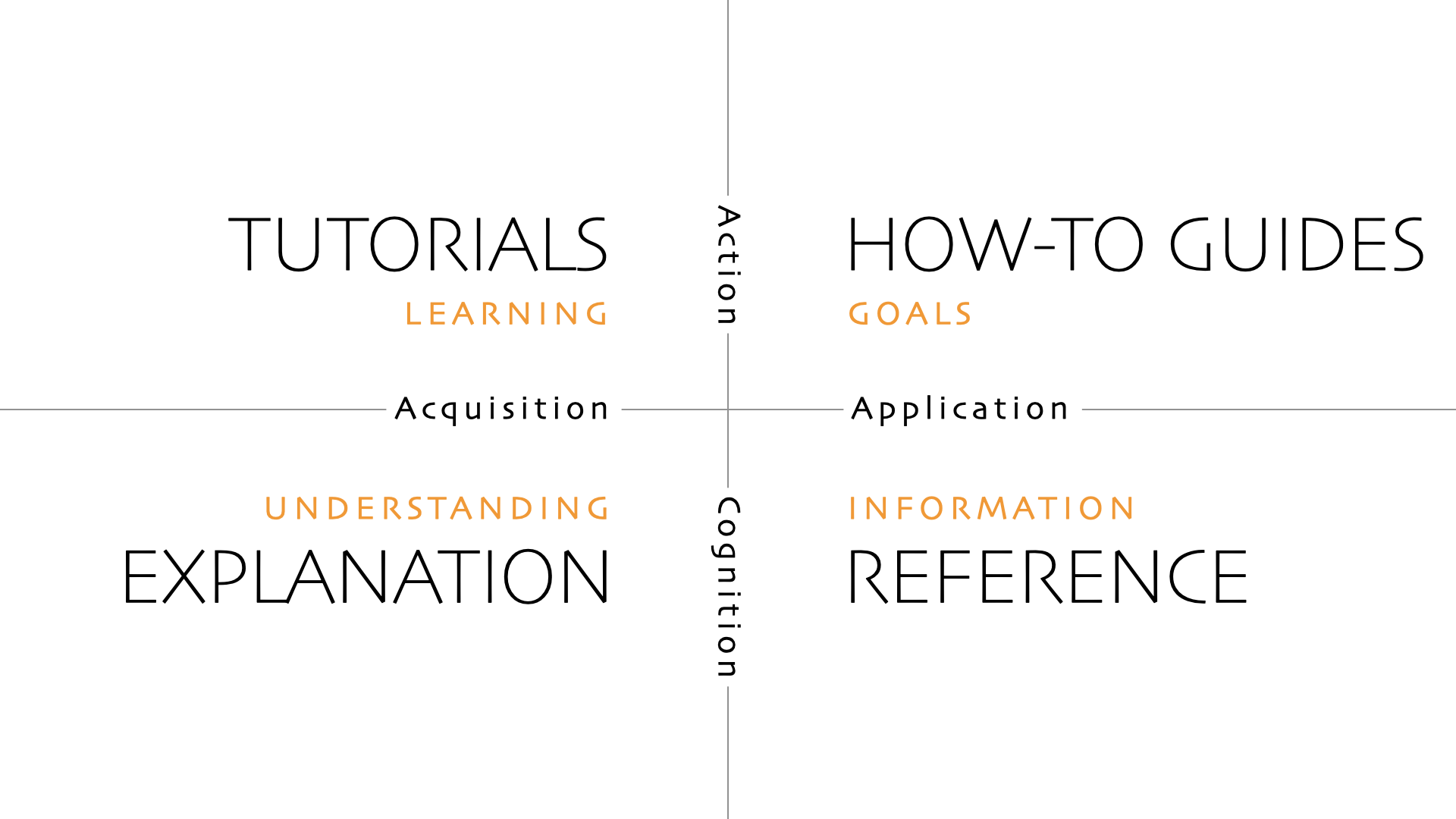
The Diátaxis framework. Diagram by Daniele Procida, diataxis.fr, licensed CC BY-SA 4.0.
The four intents map to four kinds of documentation:
- Tutorials, for the reader who wants to learn. A guided first success, where they follow you rather than look things up.
- How-to guides, for the reader with a specific task. A recipe for a real problem, assuming some familiarity.
- Reference, for the reader who needs to look something up. Precise and exhaustive. This is the quadrant Doxygen fills well, and usually the only one a C++ project has (if any).
- Explanation, for the reader who wants to understand why the design is the way it is. The tradeoffs and the reasoning behind them.
An autogenerated reference covers exactly one of these four, and shipping it alone is the mistake. The tutorial and the explanation are the hardest to write, because no tool can generate them, and they are also the ones a newcomer needs most. In the mp-units docs, this split is deliberate: the navigation is divided into Tutorials, How-to Guides, a User's Guide for understanding, and a Reference, so a visitor lands on the quadrant that matches what they actually need.
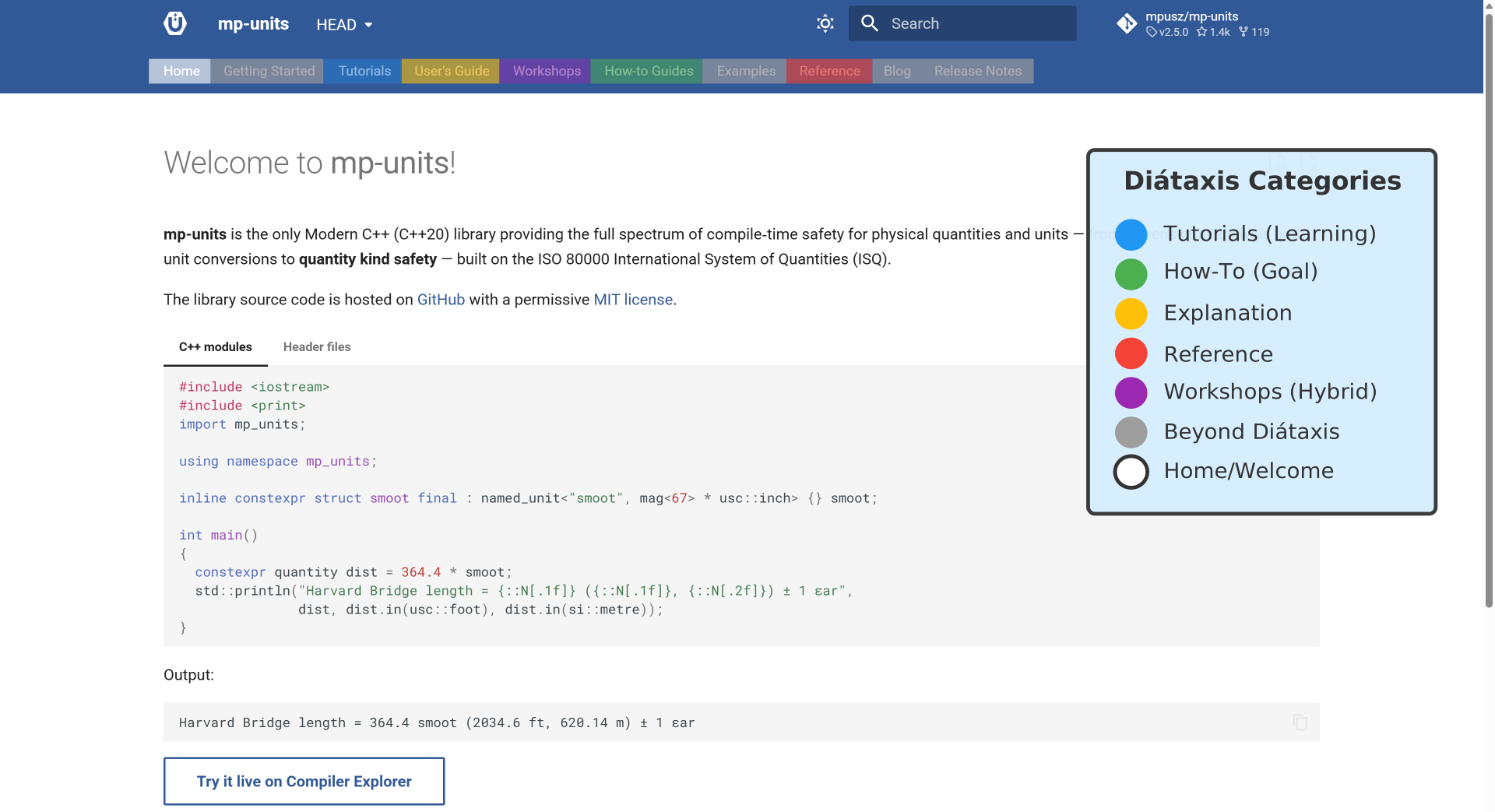
The mp-units navigation, with each section color-coded to its Diátaxis quadrant.
There is a side effect worth naming, and it is the part that helped me the most. Writing the prose works as a design review. When you try to explain an API in plain words and the explanation comes out tangled, the API is usually tangled too. "How do I even describe this?" is a reliable signal that something needs to be redesigned. On several interfaces I went through three rounds of redesign purely because the documentation refused to read cleanly, and each round left the API in a better place. Without that pressure I would have committed a design that merely worked, far inferior to what I eventually shipped once writing the docs forced the rethink.
Real documentation sites also outgrow the four quadrants, and that is fine. A getting-started ramp, worked examples that solve a whole problem, migration guides from the library you are replacing, and, for a standards-track project, a bibliography of the papers and standards behind it all earn their own space. Whatever the structure is, treat the documentation as code: it lives in the repository, it changes in the same pull request as the code it describes, and a feature isn't finished until its documentation is written.
Make the examples runnable
Engineers would rather play with a tool than read about it, and if trying your example takes more than a moment, they will skip it. If running it means cloning the repo, configuring CMake, and resolving dependencies, most readers won't bother.
The cost isn't only convenience. Typing an example builds muscle memory, and you learn the syntax of a library far faster by writing it than by scanning it. Once the code is live in front of you, you can change a unit, flip a representation type, and see what the compiler says. Breaking an example on purpose teaches more about a design than any paragraph I could write about it, and it costs the reader almost nothing. This is why I run hands-on workshops as a Modern C++ trainer instead of lecturing from slides, and documentation can borrow the same approach.
For C++, the lever is Compiler Explorer, by Matt Godbolt, and there are two ways to use it. Deep links from the docs into Compiler Explorer work, but they are a maintenance burden: as the API moves, the links drift out of date, and you usually find out only when a reader hits a broken one. What has worked far better for us is embedding Compiler Explorer directly into the interactive tutorials and the workshop material, so the example compiles and runs inside the page the reader is already on. They can edit it and break it without installing anything, and there is nothing for them to keep in sync.
Where mp-units actually is
mp-units doesn't yet follow all of the advice in this article, so here is the history, including the parts I would not repeat.
mp-units was prose-first from the beginning. The early documentation was built around Getting Started and a User's Guide, and that scope worked very well. If you are starting out, that is a pairing I would recommend: get someone to their first success, then explain the model. What I did not have at the start was Diátaxis as an explicit frame. The structure grew into the four quadrants over time, it was not designed that way up front.
The API reference was the hard part. I tried the usual C++ toolchain, Doxygen into Breathe into Sphinx, and spent most of my time fighting the parsers. The C++20 syntax the library relies on was not supported by those tools at the time, so the autogeneration simply crashed. I gave up on it, moved the whole site to MkDocs, and shipped with no generated reference at all.
A shortcut filled that gap later, and I want to flag it clearly rather than recommend it. A contributor offered to write formal specification wording for the API, and with nothing else in that quadrant we used it as the Reference. It is the only open-source project I know of that has done this, and it is not a pattern to copy. Specification wording exists to remove ambiguity for an implementer, not to teach a user, and it reads that way. It is also LaTeX-based, which made keeping it in step with an evolving library hard enough that the Reference fell behind the code.
That part is fixed. The Reference is now generated from the headers with MrDocs, which handles the C++20 and C++23 that the older toolchains choked on, so the library finally has an API reference written for the developers using it. C++26 is not there yet, as the bundled Clang does not accept contract annotations, and I expect that to come.
It is the first generator that has worked for us with nearly no trouble, and the team behind it has been genuinely responsive. A bug I reported was fixed and shipped in a release thirteen days later, which is not the turnaround I am used to. After the years I spent fighting parsers that could not read modern C++, I would recommend MrDocs to anyone documenting a project written in it.
So the documentation now covers all four quadrants: tutorials and getting started for people arriving, explanation for the model behind the library, and a Reference generated from the code it documents.
If your library is good and nobody is using it, look at the documentation before you blame anything else. Write prose for the people learning, a reference for the people who already know, and make the examples runnable. For most potential users, the documentation is the first thing they judge, long before they read a single line of your code.
These tips come from my conference talk on why technically excellent C++ libraries fail to get adopted, and how to fix it. You can watch the recording, which won best talk at using std::cpp 2026, and read the slides. I am giving an updated version of it at CppCon 2026, and the full, extended two-hour keynote at Meeting C++ 2026.