Working With Nondimensionalized Physics
This guide answers a common question from physicists and engineers who already nondimensionalize their equations: "Do I still need mp-units?"
The short answer is yes — and this guide explains why through a concrete worked example and discusses how much of the library you should use.
For background on related concepts:
- Dimensionless Quantities — how the library handles quantities of dimension one
- Preventing Integer Overflow — why overflow hazards don't disappear with dimensionless numbers
- Natural Units — for particle physics where characteristic constants (\(\hbar\), \(c\)) are compile-time
What Is Nondimensionalization?
Nondimensionalization is the process of expressing a physical problem in dimensionless form by dividing each variable by a representative characteristic scale. A position \(x\) in metres becomes \(x_* = x / X\) — a pure number relative to a reference length \(X\); a velocity \(v\) becomes \(v_* = v / V\); a time \(t\) becomes \(t_* = t / T\).
The goals:
- Numerical stability. ODE and PDE solvers work best when all variables and their derivatives stay near order 1. Mixing \(G \approx 6.7 \times 10^{-11}\) with \(M \approx 6 \times 10^{24}\) in the same arithmetic risks catastrophic cancellation or floating-point underflow.
- Equation simplification. Choosing scales so that the governing equations lose their explicit constant prefactors reduces both the number of free parameters and the opportunity for coding mistakes.
- Universality. A single nondimensionalized solver describes any instance of a problem family — Earth orbit, Moon orbit, Jupiter orbit — with only the characteristic scales \(X\), \(T\), \(V\) changing between runs.
- Interoperability. Most numerical libraries expect plain floating-point arrays. Nondimensionalization is the clean interface between typed physical inputs and untyped numerical kernels.
What is an ODE/PDE solver?
An Ordinary Differential Equation (ODE) relates a function to its derivatives with respect to a single independent variable — typically time. The gravity system \(\dot{x} = v\), \(\dot{v} = -GM/x^2\) is a classic two-variable ODE.
A Partial Differential Equation (PDE) involves derivatives with respect to multiple independent variables (e.g., both space and time in fluid dynamics or heat transfer).
An ODE/PDE solver is a numerical integration routine — algorithms such as Runge-Kutta advance the solution step by step from known initial conditions, producing an approximate trajectory. These routines typically operate on plain arrays of floating-point numbers, which is why nondimensionalization is the natural bridge between typed physical inputs and the solver's interface.
A 1-D Gravity Simulation
Consider a particle falling under gravity from an initial radius \(R\) above a mass \(M\):
\(G \approx 6.674 \times 10^{-11}\,\text{m}^3\,\text{kg}^{-1}\,\text{s}^{-2}\) is Newton's gravitational constant and \(M \approx 5.972 \times 10^{24}\,\text{kg}\) is the mass of the central body (e.g. Earth) — one very small, the other very large.
The standard remedy is to introduce characteristic scales — reference values \(X\), \(V\), and \(T\) that are representative of the problem's typical length, speed, and time — and express every variable as a dimensionless multiple of its scale:
Here \(x_*\), \(v_*\), and \(t_*\) are the new dimensionless variables; \(X\), \(V\), \(T\) are constants with dimensions that we are free to choose.
Substituting into the first equation of motion, using \(x = X x_*\) and \(t = T t_*\):
Multiplying through by \(T/X\):
For the second equation, using \(v = V v_*\), \(x = X x_*\), \(t = T t_*\):
Multiplying through by \(T/V\):
So the substituted system is:
The two prefactor coefficients \(\dfrac{VT}{X}\) and \(\dfrac{GMT}{VX^2}\) still carry all the physics. We now choose \(X\), \(V\), and \(T\) to make both coefficients equal to 1, so that they disappear from the equations entirely:
With these choices, the equations reduce to the clean dimensionless system
which contains no physical constants at all — \(G\) and \(M\) have been absorbed into the scale \(T\). The remaining free parameter is \(X\): any length scale works, and a natural choice is \(X = R\) (the initial position), so that \(x_*(0) = 1\).
The dimensionless system is what you actually hand to your ODE solver. It has no awkward constants, all variables start near order 1, and the same equations describe any central-body problem regardless of the actual mass or distance — only the scales \(X\), \(T\), \(V\) differ between problems.
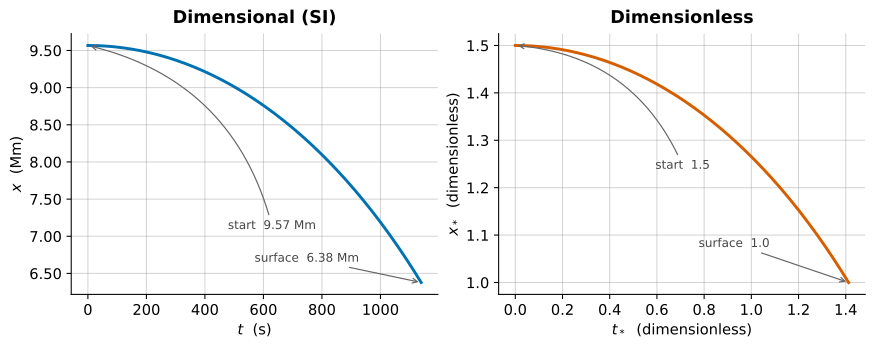
Once the solver has produced dimensionless output trajectories \(t_*\), \(x_*\), \(v_*\), you need to convert them back to physical quantities before passing them to anything in the real world — a plotting library, a telemetry system, a guidance computer. This is done by multiplying each dimensionless result back by its characteristic scale: \(t = T\,t_*\), \(x = X\,x_*\), \(v = V\,v_*\).
The Same Problem in mp-units
Three approaches are shown in progression, each building on the previous:
- Traditional approach — characteristic scales are typed SI quantities; the boundaries perform explicit dimension-checked arithmetic.
- Faster-than-lightspeed approach — compile-time named constants absorb the scales into the type system, eliminating runtime divide and multiply at the boundaries.
- Strong dimensionless types approach — dimensionless specs derived from the ISQ hierarchy extend type safety into the solver itself, making argument-order swaps and wrong-scale pairings compile errors.
Traditional Approach
Characteristic scales X, T, V are ordinary typed quantities with SI numerical
values. The entry boundary divides inputs by those large numbers; the exit boundary
multiplies results back.
Step 1: Physical Parameters
#include <mp-units/math.h>
#include <mp-units/systems/isq.h>
#include <mp-units/systems/si.h>

using namespace mp_units;
using namespace mp_units::si::unit_symbols;

constexpr quantity G = 6.674e-11 * m3 / (kg * s2);  // Newton's gravitational constant
constexpr quantity M = 5.972e24 * kg;               // Earth's mass
constexpr quantity R = 6.3781e6 * m;                // ≈ R⊕
quantity r_initial = 1.5 * R;                       // = 1.5 R⊕
quantity v_initial = 0. * m / s;                    // radial velocity (signed)
Step 2: Characteristic Scales
The library verifies dimensional consistency of the scale definitions at compile time:
QuantityOf<...> auto is optional — plain auto works too
Throughout this guide, declarations like QuantityOf<isq::duration> auto T = ... are
used to document and verify the expected quantity type at the point of definition.
Plain auto or CTAD (quantity T = ...) is equally valid and produces identical
code — the constraint only adds a compile-time assertion that the inferred type
satisfies the concept.
You only need a named type at API boundaries: function parameters, return types,
and data members. At those sites the compiler will enforce the type regardless — if
you used plain auto everywhere in between and made an error in quantity calculus
(e.g., divided by the wrong scale), the mismatch will still be caught the moment you
try to pass or store the result.
const QuantityOf<isq::position_vector> auto X = R;                         // characteristic position scale
const QuantityOf<isq::duration>        auto T = sqrt(pow<3>(X) / (G * M)); // ≈ 806 s
const QuantityOf<isq::velocity>        auto V = X / T;                     // ≈ 7909 m/s
Writing sqrt(X / (G * M)) instead of sqrt(pow<3>(X) / (G * M)) would fail to satisfy
QuantityOf<isq::duration> at that declaration — a compile error rather than a silently
wrong scale.
Step 3: Entry Boundary
Divide each input by its characteristic scale to obtain dimensionless numbers:
double x0 = (r_initial / X).numerical_value_in(one);  // 1.5 R⊕ / R⊕ = 1.5
double v0 = (v_initial / V).numerical_value_in(one);  // 0 / 7909 = 0.0
A dimension mismatch is also caught at compile time: (r_initial / T) would yield a
velocity ratio, not the dimensionless position intended.
Step 4: Dimensionless Solver
// Dimensionless RHS: dx*/dt* = v*,  dv*/dt* = -1/x*²
auto rhs = [](double x_nd, double v_nd) { return std::pair{ v_nd, -1.0 / (x_nd * x_nd) }; };

// Raw doubles are perfectly fine inside the solver
auto [t_result, x_result, v_result] = integrate(rhs, x0, v0, /*steps=*/10'000);
This is the direct answer to "do I use quantity<> throughout?"
For the integration loop itself, raw doubles are idiomatic and efficient — though
returning untyped doubles means the exit boundary retains one unavoidable blind spot,
described below.
Step 5: Exit Boundary
Multiply each dimensionless result back by its typed characteristic scale:
QuantityOf<isq::position_vector> auto x_phys = X * x_result;  // R⊕ × 1.0
QuantityOf<isq::duration>        auto t_phys = T * t_result;  // 806 s × 1414
QuantityOf<isq::velocity>        auto v_phys = V * v_result;  // 7909 m/s × (−0.817)

std::println("t = {::N[.1f]}, x = {::N[.0f]}, v = {::N[.2f]}", t_phys.in(s), x_phys.in(km), v_phys.in(km / s));
// Output: t = 1139.2 s, x = 6378 km, v = -6.46 km/s
The QuantityOf constraints guard against dimension mismatches: multiplying x_result
by T (duration) instead of X (position) would yield a quantity<isq::duration> where
quantity<isq::position_vector> is expected — a compile error, not a silent wrong answer.
Undetectable swap of dimensionless scalars
The solver returns plain doubles, so x_result, t_result, and v_result are
indistinguishable to the type system. Writing X * v_result instead of
X * x_result still satisfies QuantityOf<isq::position_vector> — the compiler
can only enforce the dimension of the scale–result pairing, not that you chose the
correct scalar for that scale. The
Strong Dimensionless Types Approach
removes this gap.
Faster-Than-Lightspeed Approach
When the characteristic scales are compile-time named constants, their SI magnitudes live in the type and their numerical values are exactly 1.0. The boundary steps then simplify:
- Entry: pass the characteristic unit directly to
.numerical_value_in(scale). When an input is already stored in that unit, no runtime division occurs — the stored value is read directly. Inputs in other units are converted automatically. - Exit: multiply the plain
doubleresult by the characteristic unit. No runtime multiplication occurs (the unit encodes the scale in its type). The large-number SI arithmetic is deferred to the output call (.in(s),.in(km), etc.) and only happens when explicitly requested.
Step 1: Physical Parameters
#include <mp-units/math.h>
#include <mp-units/systems/iau.h>
#include <mp-units/systems/isq.h>
#include <mp-units/systems/si.h>

using namespace mp_units;
using namespace mp_units::iau::unit_symbols;
using namespace mp_units::si::unit_symbols;

// IAU named constants used directly as units — SI magnitudes live in the type
constexpr Unit auto GM = GM_EARTH_N;
constexpr Unit auto R  = R_EARTH_E_N;

// r_initial is expressed directly in the characteristic unit
// its stored numerical value IS the dimensionless coordinate:
quantity r_initial = 1.5 * R;     // numerical_value_in(R_EARTH_E_N) == 1.5
quantity v_initial = 0. * m / s;
Step 2: Characteristic Scales
X, T, and V are still needed for the exit boundary, but unlike the traditional
approach they are not arrived at through nondimensionalization math — they fall out of
the IAU unit choice directly. They are pure units; the characteristic scale is encoded
in their type:
constexpr Unit auto X = R;                    // characteristic position unit
constexpr Unit auto T = sqrt(pow<3>(X) / GM); // unit R_⊕ᵉᴺ^(3/2)/(GM)_⊕ᴺ^(1/2)
constexpr Unit auto V = X / T;                // unit (GM)_⊕ᴺ^(1/2)/R_⊕ᵉᴺ^(1/2)
Step 3: Entry Boundary
Pass the characteristic unit directly to .numerical_value_in(). When an input is
already stored in that unit, no runtime division occurs; otherwise the library converts
automatically:
double x0 = r_initial.numerical_value_in(X);  // = 1.5, no runtime division
double v0 = v_initial.numerical_value_in(V);  // = 0.0
If v_initial were provided in SI units (e.g. 100. * m/s), the same call would
still correctly convert to the characteristic velocity unit — the idiom works
regardless of the input unit.
Step 4: Dimensionless Solver
The solver code is identical to the traditional approach — the dimensionless RHS is the
same \(\dot{x}_* = v_*\), \(\dot{v}_* = -1/x_*^2\). The reason it works without any
explicit nondimensionalization algebra is that GM has numerical value 1.0 in IAU units,
so the coefficient in the original equation \(\dot{v} = -GM/x^2\) is already 1:
// Original physical RHS: dv/dt = -GM/x²
// GM = 1.0 in IAU units — the coefficient is 1 automatically
auto rhs = [](double x_nd, double v_nd) { return std::pair{ v_nd, -1.0 / (x_nd * x_nd) }; };
auto [t_result, x_result, v_result] = integrate(rhs, x0, v0, /*steps=*/10'000);
Step 5: Exit Boundary
Multiply each plain double result by its characteristic unit to obtain quantity type — the
mirror of the entry step, with no runtime multiplication:
QuantityOf<isq::position_vector> auto x_phys = x_result * X;  // ≡ x_result × R_⊕ₑᴺ
QuantityOf<isq::duration>        auto t_phys = t_result * T;  // value stored in T's IAU unit
QuantityOf<isq::velocity>        auto v_phys = v_result * V;  // value stored in V's IAU unit

// Conversion to conventional SI units only happens here, on explicit request
std::println("t = {::N[.1f]}, x = {::N[.0f]}, v = {::N[.2f]}", t_phys.in(s), x_phys.in(km), v_phys.in(km / s));
// Output: t = 1139.2 s, x = 6378 km, v = -6.46 km/s
What is printed without .in(...)?
Because x_phys, t_phys, and v_phys are typed with the IAU named-constant units
of X, T, and V, printing without .in(...):
produces:
The numerical values are near 1 and the units are the IAU characteristic unit system —
physically correct and numerically well-conditioned. The .in(s), .in(km),
.in(km / s) calls perform the SI conversion only when needed.
The conversion is also lazy: all intermediate scaling factors accumulated through unit arithmetic are resolved symbolically at compile time and collapsed into a single floating-point multiply at the moment the conversion is triggered. There is no chain of sequential multiplications through the computation — and therefore no intermediate rounding errors from repeated floating-point operations.
The same QuantityOf protection and scalar-swap caveat from the traditional approach
apply here (see the warning above): the FTL approach eliminates runtime cost at the
boundaries but cannot distinguish x_result from v_result at the exit, because both
are plain doubles. The
Strong Dimensionless Types Approach
closes that gap by giving every dimensionless variable a distinct type.
Strong Dimensionless Types Approach
When a simulation uses multiple coexisting nondimensionalizations, any generic ODE engine
accepts raw doubles — it cannot distinguish a position scalar from a velocity scalar.
Argument-order swaps are therefore silent at every call site. This approach keeps the
generic engine unchanged: it still receives and returns plain doubles. What changes is
the strongly-typed wrapper around it: the wrapper's signature accepts nd_* quantities,
strips the types to forward raw doubles to the engine, and repacks raw results back into
nd_* quantities before returning to the caller. The scales build directly on the FTL
approach — the same IAU named constants as characteristic units — promoted to typed
quantities via characteristic sub-specs, from which dimensionless specs are derived as
ISQ ratios.
- Entry:
isq::position_vector / characteristic_positionresolves directly tond_position— no cast, and the wrong pairing is a compile error. - Typed wrapper: accepts
quantity<nd_position[one]>andquantity<nd_velocity[one]>, strips types to call the generic engine with rawdoubles, and repacks results intond_*quantities on return — argument-order swaps at every call site become compile errors. - Exit:
nd_position × characteristic_positionrecoversisq::position_vectorthrough ISQ algebra.
Step 1: Physical Parameters
Define the characteristic and dimensionless specs at namespace scope, alongside the
physical inputs. The explicit isq::* specifiers on r_initial and v_initial ensure
the numerator spec is exact at the entry boundary:
#include <mp-units/math.h>
#include <mp-units/systems/iau.h>
#include <mp-units/systems/isq.h>
#include <mp-units/systems/si.h>

using namespace mp_units;
using namespace mp_units::iau::unit_symbols;
using namespace mp_units::si::unit_symbols;

// Sub-specs that identify the characteristic scale quantities
inline constexpr struct characteristic_position : quantity_spec<isq::position_vector> {} characteristic_position;
inline constexpr struct characteristic_velocity : quantity_spec<isq::velocity> {} characteristic_velocity;
inline constexpr struct characteristic_duration : quantity_spec<isq::duration> {} characteristic_duration;

// Dimensionless specs derived from ISQ ratios
inline constexpr struct nd_position final
    : quantity_spec<dimensionless, isq::position_vector / characteristic_position> {} nd_position;
inline constexpr struct nd_velocity final
    : quantity_spec<dimensionless, isq::velocity / characteristic_velocity> {} nd_velocity;
inline constexpr struct nd_time final
    : quantity_spec<dimensionless, isq::duration / characteristic_duration> {} nd_time;

// Physical inputs — explicit ISQ casts ensure the correct spec at the entry boundary
quantity r_initial = isq::position_vector(1.5 * R_EARTH_E_N);
quantity v_initial = isq::velocity(0. * m / s);
Step 2: Characteristic Scales
Unlike the FTL approach where X, T, V are bare units, here they are typed
quantities — each carrying its characteristic_* spec — built from the same IAU
constants. The library verifies dimensional consistency at compile time:
const quantity X = characteristic_position(1 * R_EARTH_E_N);
const quantity T = characteristic_duration(sqrt(pow<3>(X) / (1 * GM_EARTH_N)));
const quantity V = characteristic_velocity(X / T);
Step 3: Entry Boundary
Divide each typed input by its typed characteristic scale. The ISQ algebra resolves the quotient spec automatically — no cast, and the wrong pairing is a compile error:
QuantityOf<nd_position> auto x0_nd = r_initial / X;   // position_vector / characteristic_position → nd_position ✓
QuantityOf<nd_velocity> auto v0_nd = v_initial / V;   // velocity / characteristic_velocity         → nd_velocity ✓
// QuantityOf<nd_position> auto bad = r_initial / V;  // ❌ compile error — position_vector / characteristic_velocity ≠ nd_position
Step 4: Dimensionless Solver
The generic engine is unchanged — it operates on plain doubles and has no knowledge of
nondimensionalization. The typed wrapper does the bridgework: it accepts nd_* quantities,
strips them with .numerical_value_in(one), calls the engine, and repacks the raw results
back into nd_* quantities on return. The wrapper's typed signature is what enforces
argument order at every call site:
// Generic engine — operates on plain doubles, independent of nondimensionalization
std::tuple<double, double, double>
integrate(auto rhs, double x0, double v0, int max_steps = 10'000);

// Typed wrapper — strips nd_* types, calls the generic engine, repacks results
std::tuple<quantity<nd_time[one]>, quantity<nd_position[one]>, quantity<nd_velocity[one]>>
integrate(auto rhs, quantity<nd_position[one]> x0, quantity<nd_velocity[one]> v0, int max_steps = 10'000)
{
  return integrate(rhs, x0.numerical_value_in(one), v0.numerical_value_in(one), max_steps);
}
The RHS lambda uses plain doubles — it is passed unchanged to the raw engine inside the
wrapper:
auto rhs = [](double x_nd, double v_nd) { return std::pair{ v_nd, -1.0 / (x_nd * x_nd) }; };

// Compiler enforces argument order — swapping x0_nd and v0_nd is a compile error
auto [t_nd, x_nd, v_nd] = integrate(rhs, x0_nd, v0_nd);
// integrate(rhs, v0_nd, x0_nd);  // ❌ compile error — position and velocity swapped
Step 5: Exit Boundary
Multiplying nd_position × characteristic_position recovers isq::position_vector
through ISQ algebra. The QuantityOf constraints verify the result spec at compile time:
QuantityOf<isq::position_vector> auto x_phys = x_nd * X;  // nd_position × characteristic_position
QuantityOf<isq::duration>        auto t_phys = t_nd * T;  // nd_time     × characteristic_duration
QuantityOf<isq::velocity>        auto v_phys = v_nd * V;  // nd_velocity × characteristic_velocity
// QuantityOf<isq::position_vector> auto bad = x_nd * V;  // ❌ compile error — nd_position × characteristic_velocity ≠ position_vector

// Conversion to conventional SI only happens here, on explicit request
std::println("t = {::N[.1f]}, x = {::N[.0f]}, v = {::N[.2f]}", t_phys.in(s), x_phys.in(km), v_phys.in(km / s));
// Output: t = 1139.2 s, x = 6378 km, v = -6.46 km/s
This approach closes all three safety gaps: wrong-dimension entry divisions, argument-order
swaps in integrate(), and wrong-scale exit multiplications. It is most valuable when
multiple nondimensionalizations coexist (e.g., a coupled thermal-structural simulation)
or when the integrator is called from many sites.
Overflow Does Not Disappear at the Boundaries
A common misconception: once you've nondimensionalized, all numbers are safe fractions near 1 and overflow isn't a concern.
This is true inside the dimensionless ODE — but the formation of the dimensionless ratios at entry can still overflow when using integer types. The blog post Preventing Integer Overflow in Physical Computations covers what mp-units can catch at compile time vs. what it cannot.
The key takeaway: nondimensionalization moves overflow risk from the inner loop to the entry and exit boundaries — exactly where mp-units provides protection.
Named Units for Domain-Specific Scales
The IAU constants used throughout this guide — R_EARTH_E_N, GM_EARTH_N — are
themselves named_unit instances inside the library. Their definitions follow exactly
the same pattern as any other named unit:
inline constexpr struct R_earth_equatorial_nominal final
    : named_unit<"R_⊕ₑᴺ", mag_ratio<6'3781, 10> * km> {} R_earth_equatorial_nominal;
The same pattern applies to any domain that has a standardized compile-time reference scale:
- Quantum chemistry uses atomic units: the Bohr radius
(\(a_0 \approx 52.9\,\text{pm}\)) for length, the Hartree (\(E_h \approx 27.2\,\text{eV}\))
for energy. Defining
named_unit<"a₀", ...>preservesisq::lengththrough a DFT solver exactly asR_EARTH_E_Npreservesisq::position_vectorhere. - General relativity uses geometric units (\(G = c = 1\)), collapsing mass, length, and time to a single scale.
- Particle physics uses natural units (\(\hbar = c = 1\)); the library's built-in Natural Units system covers that case.
The key requirement is that the reference scale must be a compile-time constant —
a defined standard value fixed at the problem-class level, not a quantity that varies
with runtime conditions. A scale that depends on, say, local temperature or altitude
cannot be encoded in a named_unit; it must be treated as a typed runtime quantity, as
in the Traditional Approach.
Tradeoffs at a Glance
Each approach can be evaluated along five axes:
- Entry/exit dimension — whether dividing by the wrong-dimensioned characteristic scale at entry (e.g., position by a time scale) or multiplying by the wrong-dimensioned scale at exit is a compile error.
- Argument order at call site — whether swapping arguments of different physical
meaning when calling the solver (e.g., passing velocity where position is expected) is
a compile error. In the Strong Dimensionless Types approach this is enforced by the
wrapper's typed signature; the solver body itself still operates on plain
doubles. - Exit scalar identity — whether using the wrong dimensionless result at the exit
boundary (e.g., scaling the position characteristic by the velocity result) is a compile
error. Traditional and FTL can only verify that the correct-dimensioned scale is
applied; the plain
doubleresult multiplier is indistinguishable from any other. - Zero-cost boundaries — whether entry and exit have no runtime multiply/divide.
The FTL approach can achieve this: the scale is encoded purely in the unit type, so
.numerical_value_in(X)on a value already stored in unitXis a direct memory read with no arithmetic. However, if the input is stored in a different unit (e.g., SI metres when the characteristic unit isR_EARTH_E_N), a runtime conversion factor is applied — see footnote (¹). With rawdoubles the user always divides by a large SI number explicitly. The Traditional and Strong Dimensionless Types approaches both perform a runtimedoubledivision or multiplication at the boundary; in the Strong Dimensionless Types case the stored value is1.0(no precision loss), but the operation itself is not eliminated unless the compiler can prove constancy. - Overflow protection — whether the library can detect integer overflow in boundary arithmetic involving large-magnitude quantities.
| Approach | Entry/exit dimension | Argument order at call site | Exit scalar identity | Zero-cost boundaries | Overflow protection |
|---|---|---|---|---|---|
Raw double — no mp-units at all |
❌ | ❌ | ❌ | ❌ | ❌ |
Traditional approach — typed SI scales, raw double solver |
✅ | ❌ | ❌ | ❌ | ✅ |
| Faster-than-lightspeed approach — compile-time scales, zero-cost I/O | ✅ | ❌ | ❌ | ✅ (¹) | ✅ |
| Strong dimensionless types approach — typed wrapper around the solver | ✅ | ✅ | ✅ | ❌ | ✅ |
| Full SI throughout (no nondimensionalization) | N/A | ✅ | ✅ | N/A | ✅ |
(¹) Zero-cost only when the input quantity is already stored in the characteristic unit.
If stored in a different unit (e.g., SI metres when the characteristic unit is R_EARTH_E_N),
a runtime conversion factor is applied at the boundary.
Note
The Strong Dimensionless Types approach divides by 1.0 at the boundary (because the
characteristic quantities are built from IAU constants whose stored numerical value
is 1), so there is no precision loss — but the division is still a runtime double
operation with the same cost as the Traditional approach.
Use the Traditional or FTL approach when:
- The inner loop is a generic floating-point solver (Runge-Kutta, CVODE, GSL, …)
- Runtime overhead at the boundaries matters (prefer FTL) or scales are computed at runtime (prefer Traditional)
- A single nondimensionalization is in use and argument-order safety in the solver is not a concern
Use the Strong Dimensionless Types approach additionally when:
- Multiple distinct nondimensionalizations coexist in the same codebase
- You want the compiler to guard against argument-order mistakes at every solver call site
- The integrator is called from many places or by many developers
Prefer the FTL or Strong Dimensionless Types approach over Traditional when:
- The characteristic scales are standardized compile-time constants (IAU planetary constants, Bohr radius, Hartree energy, etc.)
- You want zero runtime cost at the entry/exit boundaries
- You want full ISQ type information carried without manual SI arithmetic
Summary
Nondimensionalization and mp-units are complementary, not competing.
- Use typed
quantity<>at the boundaries: scale derivation, entry (nondimensionalization), and exit (re-dimensionalization). This is where most errors hide and where the library gives immediate, zero-overhead value. - Use raw
doubleinside the solver: the dimensionless ODE contains no units, and a plain ODE integrator operating on doubles is idiomatic and efficient. - Optionally use the strong dimensionless types approach with
characteristic_*sub-specs when multiple nondimensionalizations coexist or when function-signature safety matters. - When scales are compile-time constants, define them as
named_unitvalues to keep the scale in the type rather than multiplying it into a numerical value prematurely. - When re-dimensionalizing: the library's typed characteristic scales prevent accidentally multiplying back by the wrong scale.
- Chaining subsystems: because re-dimensionalization produces fully-typed ISQ quantities, the output of one solver is a valid, type-checked input to any downstream mp-units-aware boundary. Multiple coupled subsystems can each operate in their own characteristic units while the typed interface values flow safely between them.
The library handles the tedious bookkeeping at the boundaries of your nondimensionalized solver, so you can focus on the physics.
See Also
- Dimensionless Quantities —
is_kind,quantity_spec, and the library's treatment of dimension one - Faster-Than-Lightspeed Constants — how compile-time named constants eliminate runtime boundary arithmetic
- IAU System —
the built-in IAU units and constants (
R_EARTH_E_N,GM_EARTH_N, etc.) used in this guide - Natural Units — the built-in ℏ = c = 1 system for particle physics
- Pure Dimensional Analysis — using dimensions without numerical values for compile-time validation
- Prevent Integer Overflow — how the library protects the re-dimensionalization boundary